
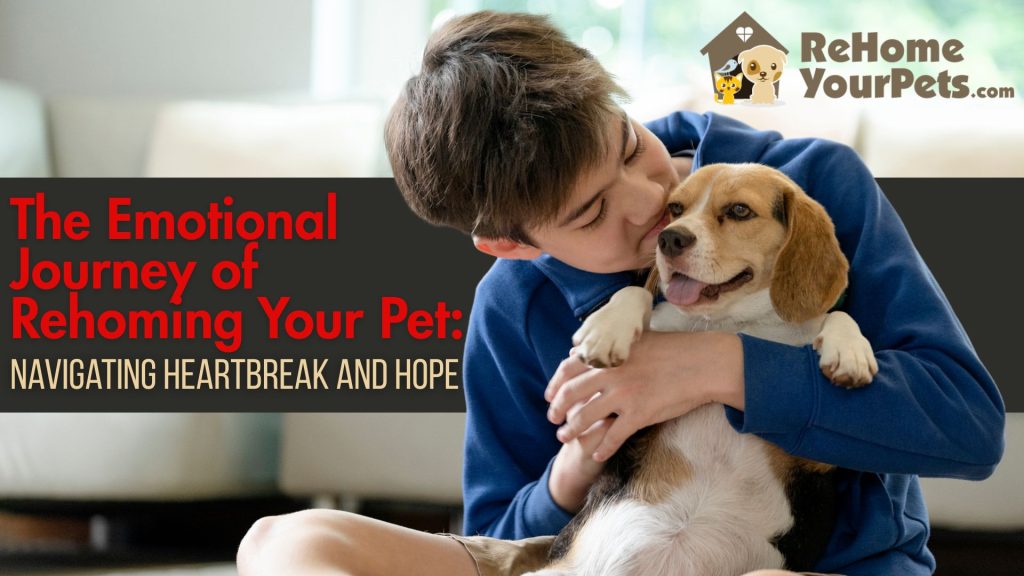
What You May Feel Before, During, and After the Rehoming Process
If you’re wondering whether it’s normal to feel sadness, guilt, or any other strong emotion during the rehoming process, ReHomeYourPets.com is here to help. In this post, we’re going to explore the emotional journey pet owners take when making the decision to rehome a pet.
We’ll take a look at common reasons for rehoming and how these reasons play into emotions, and we’ll also look at some ways to handle these emotions in a positive, healthy manner. Keep in mind, every rehoming journey is different. Your emotions are yours and yours alone, and there’s no “right” way to feel about rehoming.
A Note From Our Founder
At ReHomeYourPets.com, our mission is to help pet owners learn about responsibly rehoming pets and to help them connect with families looking to adopt. Thousands of people have turned to our website for guidance and for resources to help them navigate this transition. Pets must count on their guardians to provide them with the best home possible…whether that is in their current home or with another caring family. We all lead very busy lives, and taking the time to find a good home for a pet isn’t always quick or easy.
Here’s an actual comment from a user of our website, ReHomeYourPets.com:
“I have read through the website and I think it’s so wonderful that there’s a website that helps make such a difficult and emotional thing just a little bit easier.”
We hope that this blog article helps you to navigate the various emotions that accompany the rehoming process.
Sandy Mills, Founder, ReHomeYourPets.com
Common Reasons for Rehoming a Pet
Making the decision to rehome a pet can stem from many different life changes as well as changes in your pet’s needs. While your situation is unique, you may have run into one or more of the following scenarios:
- Financial Hardship: Sudden job loss or rising costs of veterinary care can make it impossible to provide the life a pet deserves.
- Health and Accessibility: The physical demands of pet ownership can be overwhelming to owners experiencing chronic illness or aging.
- Behavioral Mismatches: Sometimes, despite training and love, a pet’s temperament isn’t the right fit for a specific environment, such as a home with small children or other animals.
- Housing Stability: Life transitions, such as moving to a care facility or an apartment with strict pet restrictions, often leave owners with few options
Depending on your reason(s) for rehoming a pet, you may experience different emotions. It’s important to note that your emotions are valid, and most importantly, you’re doing the right thing for your pet when you seek out options to responsibly rehome them.
The Emotional Journey of Rehoming a Pet: What You May Experience
The emotions surrounding rehoming may follow a predictable path, but they aren’t always linear. In fact, you might feel three different things in a single hour or your emotions may change over time. Understanding these feelings can help you process your emotions without judging yourself.
Below are some common emotions people feel before, during, and after the rehoming process:
Sadness and Worry
You may be sad that you’re in a situation where you even have to consider rehoming your pet, and you may wonder if you have explored every possible avenue to keep him or her. You may also worry about finding your pet the right home and family.
Grief
This will be a loss, plain and simple. Even when you know the decision is the right thing to do, the absence of your pet’s presence in your home will create a void. It’s okay to mourn the end of this specific chapter of your life. Allow yourself to feel sadness and grief, but try not to dwell on these feelings.
The Cycle of Guilt and Relief
This is perhaps the most difficult combination. Some pet owners may feel a sense of relief, especially if their pet had complex needs that required more time, energy, and financial resources than they were able to provide. However, if you are successful in finding a wonderful, caring home that meets your pet’s needs, any sense of guilt will be short-lived.
Calm and Clarity
Once the transition is complete and you know that your pet is thriving, a sense of calm usually follows. You realize that your decision was an act of stewardship, not abandonment. The peace that comes along with this realization can help you to move forward in life.
Happiness and Joy
It may seem counterintuitive, and you may not feel it at first, but happiness is a common part of the rehoming journey. Many pet owners find that focusing on the security of knowing your pet has found the “perfect match” can help foster feelings of happiness in the rehoming process. Knowing that your pet will have a yard they love, a companion they click with, and the loving care they need and deserve brings a profound sense of satisfaction, even if it’s bittersweet.
Real Stories: Finding the Right Path
Brian and Oscar: From Sadness to Hope
Brian had to move into an assisted living facility that didn’t allow his 10-year-old cat, Oscar. He was heartbroken, fearing Oscar would spend his final years in a cage. Through a responsible rehoming process, he found a quiet household looking for a lap cat. “Seeing a photo of Oscar curled up on someone else’s sofa didn’t make me feel replaced,” says Brian. “It made me feel successful. I kept my promise to Oscar to always keep him safe.”
Sarah’s Story of Guilt and Peace
“I felt like a monster because I was feeling lighter after my high-anxiety dog went to his new home,” says Sarah. “I loved him, but I was constantly on edge. It took talking to a friend to realize that my relief wasn’t because he was gone, but because I knew he was finally in a quiet environment where he wasn’t scared anymore. That realization turned my guilt into peace.”
*Names have been changed to protect anonymity.
Tips for Managing the Transition
Acknowledge the “Why”
To help bring calm and clarity to the rehoming process, remind yourself of the specific reason(s) you are doing this. Usually, it is because you want a better life for the pet than you can currently provide, and the love and strength you show in seeking this path outweighs any sadness over time.
Seek Support
Talk to friends or family members who understand the bond you have with your pet. You can also seek out online resources to explore your emotions. In some cases, joining a support group can help you find peace with your decision to rehome your pet.
Trust the Vetting Process
Using a platform like ReHomeYourPets.com allows you to have a say in where your pet goes. When you know that your pet is going to a home that you have vetted and where you are sure they will be loved and cared for, you can receive a sense of emotional closure that shelters often cannot offer.
No matter what emotions you feel, ReHomeYourPets.com wants to make it easier to not only rehome your pet responsibly, but also to make the process as stress-free as possible.
To learn more about the rehoming process and how we can help, check out our Getting Started section for tips.
You can also explore our ReHoming Tips page for more insights from experienced rescuers.
This content was produced in partnership with Charlotte Content Marketing.